
Check the Stitching: Is Your Omnichannel Talking to Each Other?

TL;DR by Tippy
An overwhelming majority of Gen Z customers use multiple digital and physical channels to complete a purchase
Customers expect a seamless brand experience from digital to physical
Social media has helped bring brands closer to their customers, building stronger relationships and driving sales
Customer Relationship Management (CRM) systems help retailers to track and engage throughout the customer journey
CRM-integrated Point-of-Sale (POS) help staff to deliver exceptional service in-store while also providing additional customer data for long-term engagement
Source: Pavel Danilyuk | Pexels
Imagine going to a friend’s birthday party and you run into someone that you met at last year’s festivities. You drank, laughed, and made fools of yourselves on the dancefloor. But now they don’t remember you at all and reintroduce themself. Not only is this alienating but it's not encouraging because now you're thinking, "Well, they're just going to forget me again, so this is a waste of time."
This happens in retail too, and it makes customers feel like a faceless number. That's why building a strong customer relationship helps drive sales because they feel seen and appreciated.
Omnichannel retail ensures there's continuity at every touchpoint. As Canadian commerce platform giant Shopify defines it, "Omnichannel retailing is a fully integrated approach to commerce, providing shoppers a unified experience across all channels or touchpoints."
In this phygital age, full integration across all channels isn't just a nicety, it's a necessity; omnichannel customers spend 1.5x more than single channel customers.
Your customers expect your omnichannel to speak to one another, from email to TikTok, YouTube to brick-and-mortar.
We know what you're thinking, "This sounds nice but how can I integrate an omnichannel into my retail process?" Don't worry, you have most of the answers in front of you.
You just have to know where to look and how to seat all your data at the table.
Social Commerce: TikTok Shops and YouTube Merchandizing
It shouldn’t be a surprise that customers are shopping while doomscrolling. Consider these numbers from World Metrics:
Gen Z is on social media over 3 hours a day
82% of 25-34 year olds use social media daily
72% of 35-44 year olds use social media daily
Social commerce is the process of selling products and services directly within social media platforms. This streamlines the customer journey, allowing users to discover, browse, and purchase items without ever leaving the app or pausing their scroll session.
source: Salesforce
Despite Gen Z having significant buying power, this consumer base is also strapped for time as they juggle work and family life. So many turn to convenience. And what's more convenient than seeing their favorite influencer advertise a pot they've been eyeing for the last week? Add to cart!
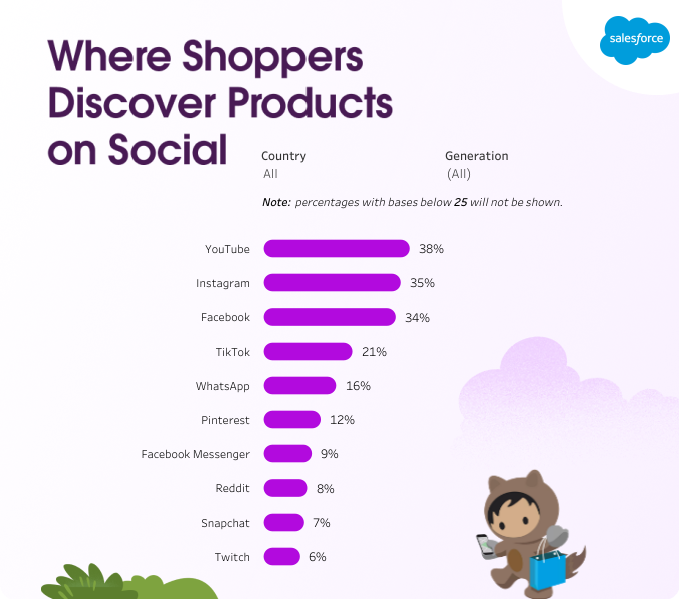
Social commerce has struck the perfect chord for many consumers. Industry leading Customer Relationship Management (CRM) platform Salesforce released their 2025 Connected Shoppers Report citing that 76% of Gen Z use social media to find products.
Check out the breakdown below:
Source: Salesforce
By leveraging social commerce, you're able to build trust right in the palm of your customer's hand (or from their laptop or smart TV). If you're targeting properly, you're placing your product in front of eyeballs that are already interested in your product segment and may even be engaging with related content.
Now this is all dandy for the swipers and likers but how do you get your channels connected and talking to each other? That's where your CRM and Point-of-Sales (POS) come in.
Customer Relationship Management – Point-Of-Sale Integration: Where the Customer Picture Comes into Focus
Shopper behavior has changed drastically over the years. Yet, some things haven't changed, like how customers are still window shoppers. The only thing is that the window is a mini super-computer that lives in your front pocket.
The issue with shopping on your phone are the countless distractions: notifications from other apps, texts from your mom, Slack messages from your boss, and other dings than make your device sound like a wind chime.
So, to keep track of every engagement and re-target ads to those who've engaged with you in the past, having a sound CRM platform is critical. But sometimes digital isn't enough and it takes the in-person experience to finalize the sale. This is where having a comprehensive POS system that integrates with your CRM is crucial.
Many high-value customers take an omnichannel approach, where online browsing can lead to in-person purchases and vice-versa. This is especially true when you think of the purchasing behavior of a digitally native consumer. Key players in the space such as Square, Shopify, and Lightspeed integrate across multiple social media platforms, your e-commerce site, email, and physical POS systems.
For example, someone might see a projector on Instagram through his discovery page. He then goes on a retailer's website to see the specs. It has everything he's been looking for but he wants a second opinion, so he searches on Reddit to see what the community is saying. He finds Reddit on Google, of course. Then, he hops on YouTube to see if there are any reviews so he can see the picture quality and frame rate. He's ultimately undecided, so he bounces back to Google to find his closest electronics store to see the product in person.
At each one of these touchpoints, you're building a relationship with the customer, especially since the engagement began on social. After completing the purchase in store, the POS has completed the loop and provided additional data on the customer. With an integrated POS-CRM platform, you're tracking the shopping experience from beginning to end. This process gives you the bird’s eye-view you need to maintain strong customer relationships.
Smart Clienteling: Understanding Your Customer
By using a CRM-integrated POS system, you have a customer’s history at your fingertips. This means you're able to deeply understand your customer and make promises that hold up across the entire customer experience. You know about abandoned carts and clicked product links. You can then inquire about it when they come in-store.
Retail clienteling allows businesses to keep track of purchases, giving in-store associates the power to identify not only the most loyal customers but also their preferences.
source: Salesforce
When your POS offers real-time information about your customer, you're able to make more precise suggestions and understand what type of products they may be currently shopping for. You're can also see past purchases and make complementary suggestions, giving your customers a better overall shopping experience.
This process makes customers feel acknowledged and seen while also helping from a very practical sense, such as returns. Gone are the days of missing receipts since all purchases are now inventoried. Plus, loyalty rewards and coupons can be suggested in the moment, a very pleasant surprise for customers.
CRM-POS integration also helps with post-purchase follow-up, as automated emails can be sent for satisfaction purposes, reviews, and additional value-add marketing communications, such as care guides.
Omnichannel Retail: Highlighting Your Customers
Taking an omnichannel approach supports a better experience for your customers, your associates, and marketing managers. This heightened visibility of customer needs helps retailers pinpoint exactly when and where they can step up to provide exceptional service.
By integrating your Customer Relationship Management system and Point-of-Sale, you provide your team with the resources to not only show up the way your customers want but also build stronger relationships.
As new customer expectations emerge, namely the widespread adoption of Artificial Intelligence, having a fully integrated omnichannel system helps give you the customer snapshots needed for growth.
Like they used to say at the end of the 80’s cartoon series G.I. Joe, "Knowing is half the battle." And with this knowledge you're equipped to be there for your customers every step of the way.
Start understanding your customers with a Continuous Experience Evaluation