
Striking a Balance Between Retail Security and A Better Customer Experience

TL;DR by Tippy
Organized retail crime (ORC) and violent retail theft have increased significantly; there’s a 93% rise in the average number of shoplifting incidents per year in 2023 versus 2019 (National Retail Federation)
Retailers are collaborating with technology companies to implement AI-enhanced security measures to prevent and deter theft
Good customer service is a key deterrent to shoplifting
Store layout and lighting also play critical roles in preventing theft
Most consumers who were interviewed value security but don’t want it to interrupt their shopping experience
Improving retail security has never been more widely discussed than it is now. Shoplifting has only become more rampant, more organized, and more brazen. While retailers want shoppers to have an enjoyable experience, they must also be cognizant of violent thefts that often occur.
As incidents of organized retail crime (ORC) continue to rise, retailers have witnessed huge increases in financial losses. Retail giants such as Target have been forced to close nine stores across several U.S. cities due to repeat theft incidents.
A study conducted by the National Retail Federation (NRF) highlights that retailers reported a staggering 93% rise in the average number of shoplifting incidents per year in 2023 versus 2019.
While many retailers have taken steps to enhance security measures, a fine balance needs to be struck between deterring theft, creating a safer shopping environment, and improving the overall customer experience.
Let’s explore the loss prevention (LP) solutions retailers are implementing and what customers really want from their shopping experience.
Leveraging Cutting-Edge Technology for Retail Security
As ORC syndicates evolve and become more sophisticated in their approach to retail theft, retailers are also using the latest technology for their security and loss prevention efforts. In a study by NRF, around 53% of retailers planned to invest in more security software solutions and technology, year-over-year.
CNBC highlights how retailers and tech companies are joining forces to deploy new LP solutions such as:
Advanced video surveillance systems
Facial-recognition cameras
Radio-frequency identification (RFID) tags
License-plate and vehicle readers
Predictive analytics software
Smart case locks
Autonomous security robots to curb in-store theft
While some of this technology has been around for a while, it’s now being reinforced by AI, significantly enhancing its capabilities, such as:
Video surveillance that immediately warns store security if criminal activity is detected.
Facial recognition software that detects suspects.
RFID soft tags that cannot be detected by shoppers or shoplifters, helping law enforcement track stolen merchandise.
Retailers are using this technology not just to catch shoplifters in the act, but also to deter would-be thieves.
Dr. Read Hayes, Director of the Loss Prevention Research Council, articulated this objective clearly; “The first thing we look at is, can we detect these people and identify them before there are victims? We’re trying to get an offender or crew to say, ‘Not here, not now, this doesn’t feel right.’”
The deployment of new technologies and AI is helping retailers elevate their loss prevention strategies. Sam’s Club exemplifies this. When customers make a purchase, the AI installed at store exits then documents the products in the carts. Next, the system scans the cart’s content and links them directly to the member’s receipt. This makes theft more challenging while also expediting customer checkout.
“The first thing we look at is, can we detect these people and identify them before there are victims? We’re trying to get an offender or crew to say, ‘Not here, not now, this doesn’t feel right.’”
Dr. Read Hayes, Director of the Loss Prevention Research Council [Source: CNBC]
Reduce Loss Prevention with Trained Sales Staff, not Guards
While having security guards patrolling the store could potentially discourage theft, retailers do so at the risk of disrupting the customer experience. Nobody wants to do their shopping and feel like they’re being watched or followed. Not only does this create tension, but it could also influence shoppers to go elsewhere.
Having trained sales associates walk the floor and actively engage with customers would be a better alternative. Loss Prevention Magazine elaborates on how good customer service is an effective deterrent against shoplifting:
Shoplifters don’t want to be engaged or spoken to in-store.
Engaging the customer proactively prevents theft, as the attention is now on them.
Attentive staff raise the risk among potential shoplifters that they could be identified and apprehended, forcing them to leave the store.
For shoplifters, speed and agility are the key objectives. They go in, steal the products, and leave the store as quickly as possible, preferably undetected. Using a customer service-centered approach enables vigilant sales associates to engage customers, keep a lookout for suspicious behaviors or tactics used by thieves, and ultimately, prevents shoplifting.
Better Store Layouts Lead to Improved Customer Experience
On top of having advanced technology and trained staff, a good retail store layout also plays a critical role in preventing theft.
Criminals are opportunists. They’re quick to identify and exploit retail stores that have flaws such as hard-to-monitor areas, weak security, and understaffing.
Rocateq points out the advantages of having a store layout designed to prevent theft:
It enhances lines of sight and decreases blind spots so that the store feels open, inviting, and safe.
It provides a subtle element allowing security to be included in the design to deter shoplifting while not making customers feel uncomfortable.
It also prevents theft and improves the shopping experience.
Apple stores clearly demonstrate the effectiveness of this method. Every store has a well-lit open “coffee bar” layout. People can touch and experience the products while staff actively engage with them. Aside from having security cameras everywhere, the stores also incorporate anti-theft features into their products. When the devices are removed from the store's premises, they switch to lost mode and cease to function.
What Customers Really Want: Balance
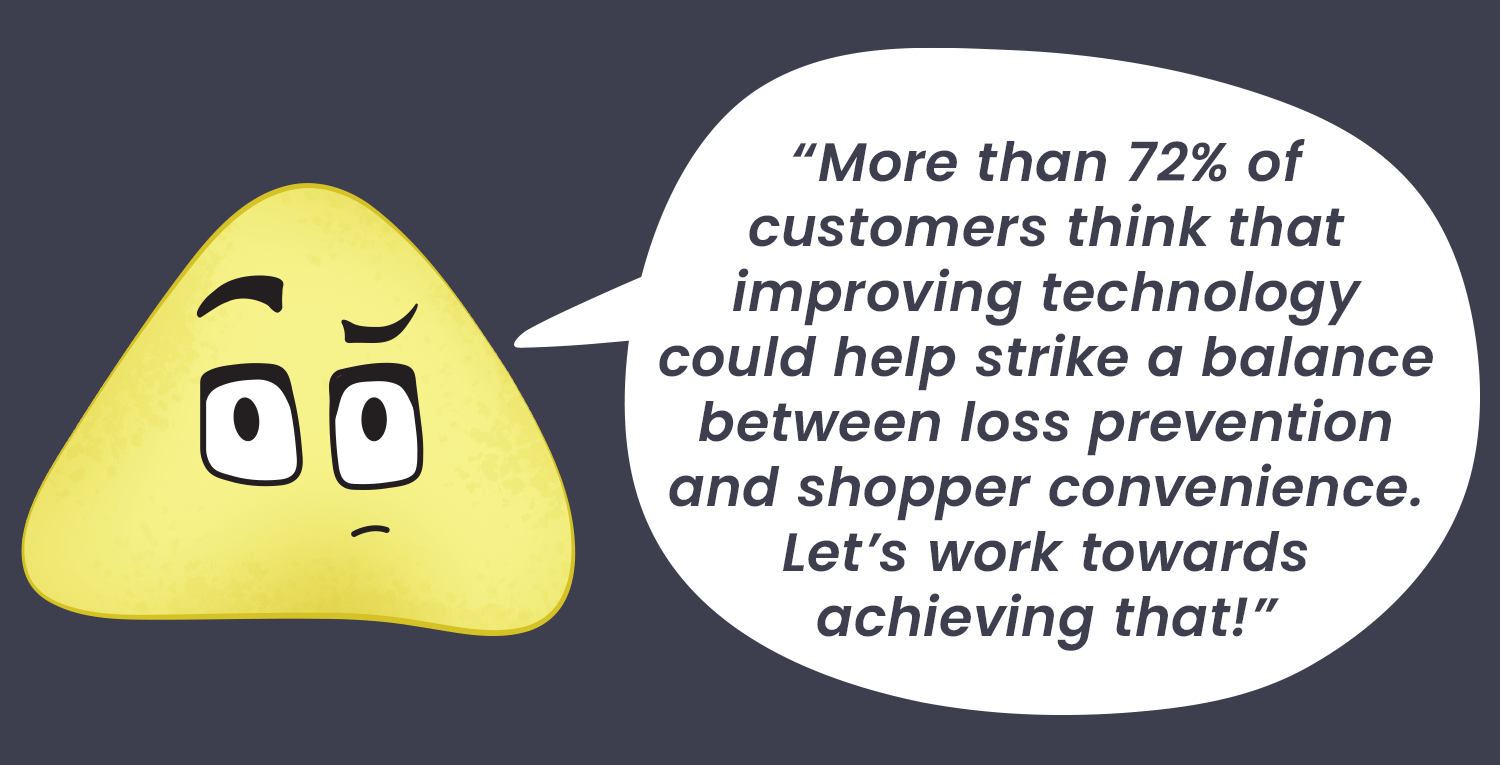
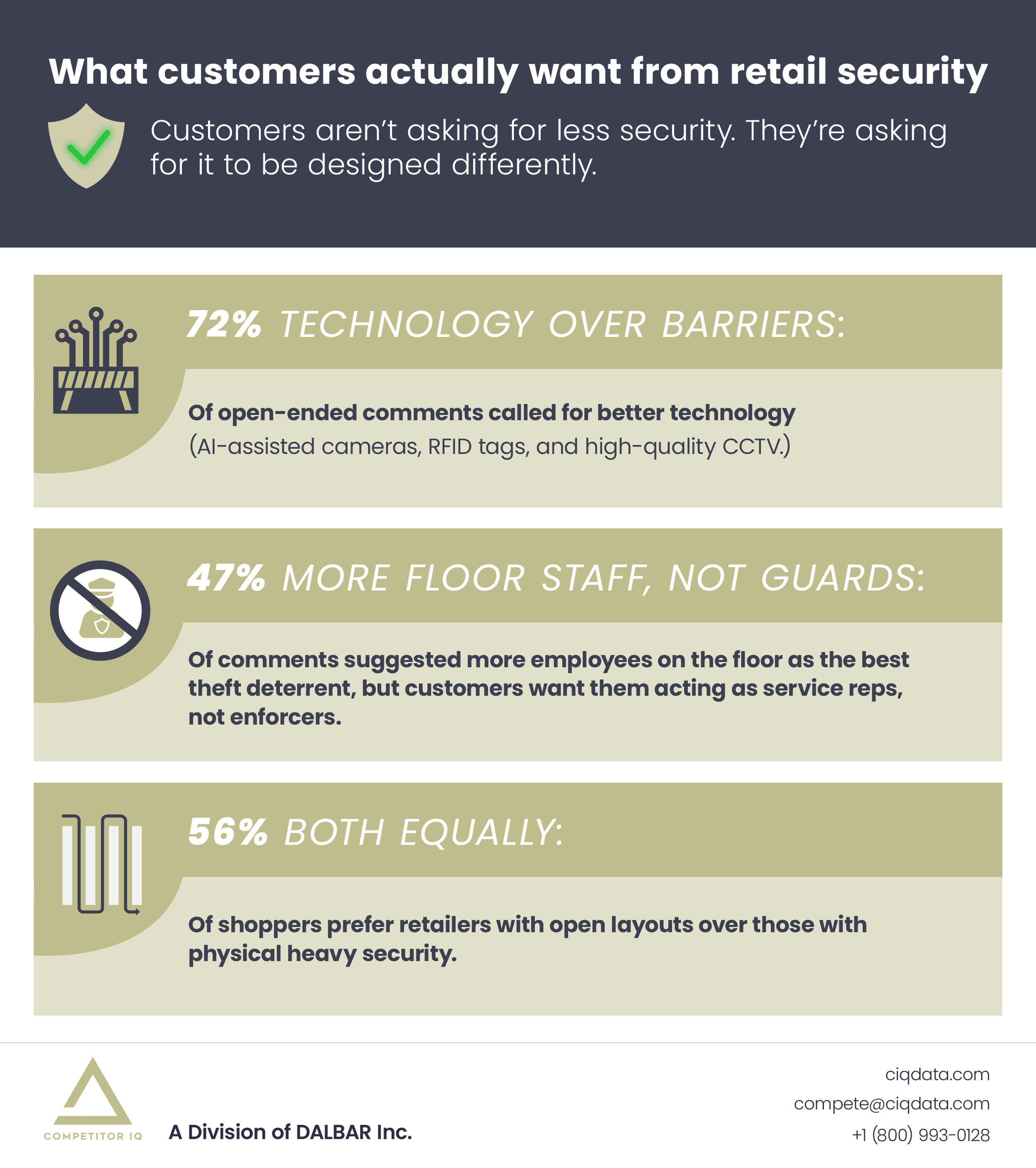
At Competitor IQ, we conduct retail security and loss prevention studies. In our research, customers felt that a retail security and loss prevention strategy combining physical and technological features was the right approach. While they value safety and security in-store, they also feel it shouldn't interrupt their shopping experience.
Many pointed to locked merchandise as a key source of frustration, mentioning they prefer security measures that don’t impede their ability to interact, browse, or check merchandise packaging. Respondents aged 35-44 seemed to be the most frustrated with locked cabinets. They also prefer retailers to incorporate technology that doesn’t punish the honest shopper such as exit alarms, RFID tags, and CCTV.
While it’s important for retailers to strike a balance between security and customer experience, many loss prevention measures are impacting customers negatively:
Bottlenecks and delays, resulting in frustration among shoppers.
The impression that the store is a high-risk area.
Frustration among shoppers, resulting in an unwillingness to return to the store.
Retailers would be wise to take this feedback into consideration. Zendesk points out that 50% of consumers are likely to switch to a competitor after one bad experience. Shoppers have made it clear that security is important, but it shouldn’t be implemented at their expense.
Based on these findings, how can retailers balance improving in-store security while creating a better shopping experience for customers?
Deploy technologies that are less intrusive, reducing unnecessary delays and shopping disruptions.
Hire more sales associates instead of security guards and train them to actively engage customers and deal with shoplifting incidents safely.
Audit current store layout: create areas where products are visible to staff, improve lighting, install sections where customers can interact with products, and set up cameras or mirrors to monitor blind spots.
Balance Retail Security and Customer Experience for Greater Success
With ORC on the rise and shoplifting exploding, our obligation as retail leaders is to mitigate this issue while ensuring we don’t disrupt the shopping experience.
You heard what customers had to say: They’re not against you implementing security measures; they’re against the inconvenience caused by it. Creating excessive friction in their shopping journey will lead to customers abandoning their purchase and switching to competitors.
Strike that balance. Implement advanced technologies and AI to help prevent shoplifting, monitor suspicious behavior, and deter suspects from stealing. Hire and train staff to be more engaging with customers and vigilant of those who have bad intentions, and design stores so that products are highly visible.
If you’re able to find that sweet spot between increasing retail security, reducing loss, and improving customer experience, you’ll be on your way to creating a safe shopping environment filled with customers who are eager to return.
Looking for more insights?
Get a copy of Competitor IQ's Retail Security & Loss Prevention Study